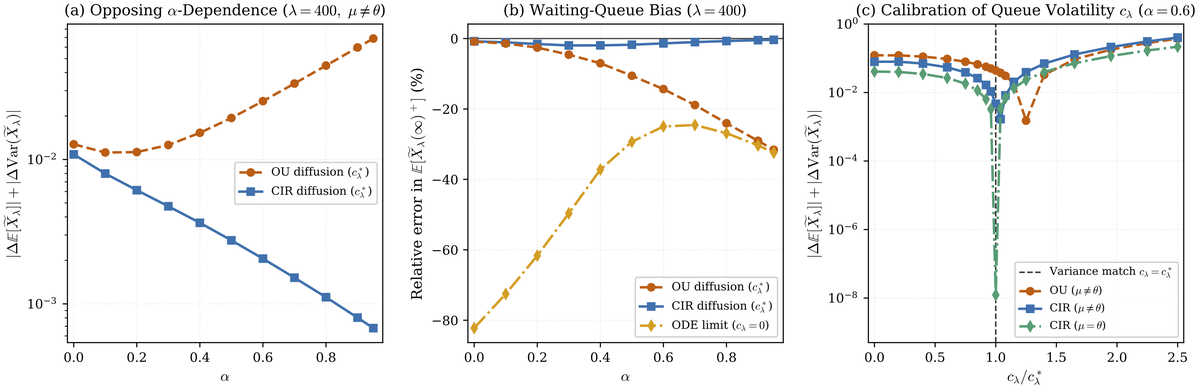
We study steady-state diffusion approximations for a many-server queue driven by overdispersed arrivals from a doubly stochastic Poisson process. Its arrival intensity follows a generalized Cox–Ingersoll–Ross (CIR) process, where $\alpha \in [0, 1)$ governs how the arrival-count variance scales as $\lambda^{1+\alpha}$ with the baseline arrival rate $\lambda$ under Taylor’s law. For $\alpha > 0$, arrival-intensity fluctuations grow faster with $\lambda$ than counting fluctuations from arrivals and departures, so normalizing by $\lambda^{(1+\alpha)/2}$ pairs a nonvanishing intensity volatility with a vanishing queue-length volatility. This two-scale formulation differs critically from conventional diffusion approximations, which either apply a single $\lambda^{1/2}$ scaling with nonvanishing volatilities or drop the vanishing queue-length noise in the heavy-traffic limit. Retaining both scales, we compare two diffusions: one replaces the scaled intensity with its limiting Ornstein–Uhlenbeck (OU) process, and the other preserves the exact CIR intensity. Using Stein’s method, we establish steady-state error bounds for smooth test functions of arbitrary polynomial growth that depend on $\alpha$ in opposite directions. Both diffusions achieve the classical $O(\lambda^{-1/2})$ rate at $\alpha = 0$. For $\alpha \in (0, 1)$, however, the OU rate degrades to the sharp order $O(\lambda^{-(1-\alpha)/2})$, whereas preserving the CIR intensity improves the rate to $O(\lambda^{-(2+\alpha)/4})$. Our proofs establish new derivative bounds for the associated Poisson equations that remain valid when the diffusion has vanishing volatility and nonsmooth drift.