AI Persuasion, Bayesian Attribution, and Career Concerns of Decision-Makers
Feb 4, 2026·


 ·
0 min read
·
0 min read
Hanzhe Li
Jin Li
Ye Luo
Xiaowei Zhang
Abstract
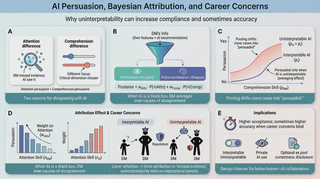
This paper studies AI persuasion by distinguishing between two reasons for disagreement: attention differences, where the AI detects features the decision-maker missed, and comprehension differences, where the AI and the decision-maker interpret observed features differently. We show that AI is more effective in persuading the decision-maker when the disagreement is due to attention differences rather than comprehension differences. We also show that the AI’s interpretability shapes how the decision-maker attributes the sources of disagreement and, in turn, whether they follow the AI’s recommendation. Our main result is that making AI uninterpretable can actually enhance persuasion and, in the presence of career concerns, improve decision accuracy.
Type
Publication
Management Science, 2nd Round Review


Authors
Zhang Yonghong Professor in Economics and Strategy, Director of the Centre for AI, Management and Organization (CAMO), and Area Head of Management and Strategy at HKU Business School.

Authors
Asociate Professor in Economics and Finance, Associate Director of the Institute of Digital Economy and Innovation at HKU Business School.

Authors
I am an Associate Professor at HKUST, jointly appointed in the Department of Industrial Engineering and Decision Analytics and the Department of Economics, and the Academic Director of the MSc in FinTech program. I serve as an Associate Editor for several leading journals in the field, including Management Science, Operations Research, Navel Research Logistics, and Queueing Systems.