Sample and Computationally Efficient Stochastic Kriging in High Dimensions


Abstract
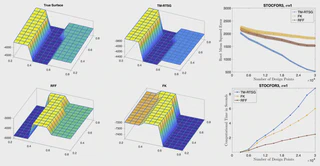
Stochastic kriging has been widely employed for simulation metamodeling to predict the response surface of complex simulation models. However, its use is limited to cases where the design space is low-dimensional because, in general, the sample complexity (i.e., the number of design points required for stochastic kriging to produce an accurate prediction) grows exponentially in the dimensionality of the design space. The large sample size results in both a prohibitive sample cost for running the simulation model and a severe computational challenge due to the need to invert large covariance matrices. Based on tensor Markov kernels and sparse grid experimental designs, we develop a novel methodology that dramatically alleviates the curse of dimensionality. We show that the sample complexity of the proposed methodology grows only slightly in the dimensionality, even under model misspecification. We also develop fast algorithms that compute stochastic kriging in its exact form without any approximation schemes. We demonstrate via extensive numerical experiments that our methodology can handle problems with a design space of more than 10,000 dimensions, improving both prediction accuracy and computational efficiency by orders of magnitude relative to typical alternative methods in practice.
Type
Publication
Operations Research 72(2):660–683
Simulation Metamodeling
Stochastic Kriging
Gaussian Process
Tensor Markov Kernel
Sparse Grid
Experimental Design
Matrix Inversion
High-Dimensional
Convergence Rate


Authors
I am an Associate Professor at HKUST, jointly appointed in the Department of Industrial Engineering and Decision Analytics and the Department of Economics, and the Academic Director of the MSc in FinTech program. I serve as an Associate Editor for several leading journals in the field, including Management Science, Operations Research, Navel Research Logistics, and Queueing Systems.