How Does Risk Hedging Impact Operations? Insights from a Price-Setting Newsvendor Model


Abstract
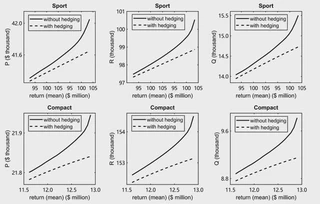
If a financial asset’s price movement impacts a firm’s product demand, the firm can respond to the impact by adjusting its operational decisions. For example, in the automotive industry, car makers decrease the selling prices of fuel-inefficient cars when the oil price rises. Meanwhile, the firm can implement a risk-hedging strategy using the financial asset jointly with its operational decisions. Motivated by this, we develop and solve a general risk-management model integrating risk hedging into a price-setting newsvendor. The optimal hedging strategy is calculated analytically, which leads to an explicit objective function for optimizing price and ``virtual production quantity’’ (VPQ). (The latter determines the service level, i.e., the demand fulfillment probability.) We find that hedging generally reduces the optimal price {when the firm sets the target mean return as its production-only maximum expected profit. With the same condition on the target mean return}, hedging also reduces the optimal VPQ when the asset price trend positively impacts product demand; meanwhile, it may increase the VPQ by a small margin when the impact is negative. We construct the return-risk efficient frontier that characterizes the optimal return-risk trade-off. Our numerical study using data from a prominent automotive manufacturer shows that the markdowns in price and reduction in VPQ are small under our model and that the hedging strategy substantially reduces risk without materially reducing operational profit.
Type
Publication
Management Science 70(7):4167-4952


Authors
Assistant Professor in the Department of Operations and Risk Management at Lingnan University.

Authors
I am an Associate Professor at HKUST, jointly appointed in the Department of Industrial Engineering and Decision Analytics and the Department of Economics, and the Academic Director of the MSc in FinTech program. I serve as an Associate Editor for several leading journals in the field, including Management Science, Operations Research, Navel Research Logistics, and Queueing Systems.